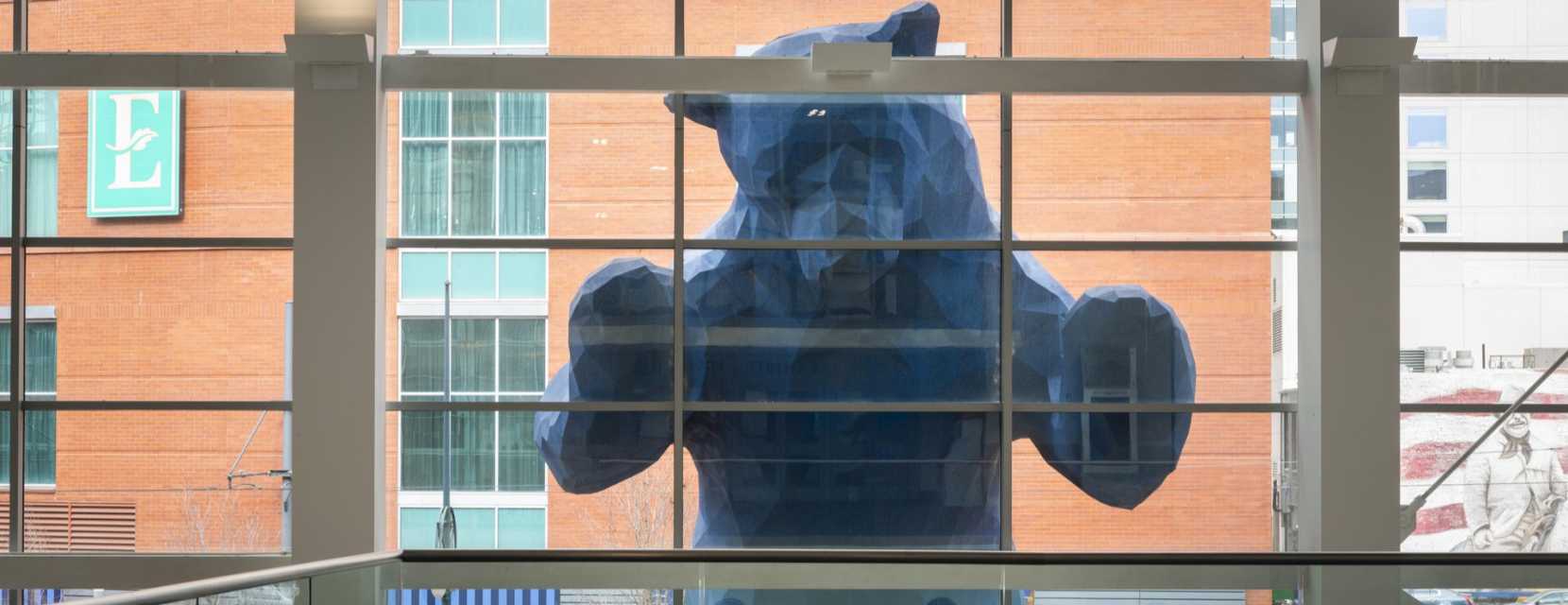
An Interview with Lawrence Argent
Before his death in 2017, we spoke with Argent about the inspiration behind Denver's beloved blue bear, the role of public art and why curiosity was at the heart of his iconic creation.
Visit Denver: How does it feel to be the creator of an artwork that's quickly become a Mile High City icon?
Lawrence Argent: Who would've thought [laughs]? It's interesting — it doesn't happen all the time, that's for sure. Before it was installed, I'd tell people that I was working on a 40-foot blue bear for the Colorado Convention Center , and they'd look at me and say "What - are you working for Disney now?" But once it was up they'd say "Whoa, it's amazing." To me, it's kind of like the bear needs the building, and the building needs the bear.
Visit Denver: What was the genesis of "I See What You Mean" come from?
Lawrence Argent: While toying with the notion of a "Convention Center" and visualizing the vast numbers of people moving through and participating with this environment, my proposal emerged as a core response to the following: Meeting place; Exchange of ideas, transference of information; Regional western art and the thought of what that is from a non-resident's perspective; and the natural surroundings of Colorado. The architecture of [the convention center] is such a dominant presence in the location I thought it best to place a work that did not conflict with the essences of its design or stature, and which would embrace its uniqueness of form and the relationship to the space it occupies. Scale therefore, became an extremely important consideration. I also wanted to bring the mountains (the assumed idea of Colorado) down to Denver to prompt visitors' awareness of the uniqueness of their location.
Visit Denver: Why a bear? Why a giant, curious blue bear, specifically?
Lawrence Argent: There's iconic Colorado imagery — the Rockies, the Flatirons and all that — that I think is a little bit overused, a little passé. So I thought about what it is like to be a resident here and the journey one takes down either corridor (14th St. and Speer Blvd) when one notices there is a convention occurring. I'm always interested in what might be going on in there, the exchange of information, ideas and ideologies. But there's never really any indication from the outside what's going on inside. I had recently seen a photo in the newspaper of a black bear looking into someone's window and that resonated with me. As for the blue color, that was actually an accident - originally the bear was going to reflect the colors of Colorado, with sandstone colors and things like that. But a printout of the design came back blue by mistake, and I thought that was much more exciting. And it was serendipitous, because [I learned later] that the black bear was very important to the Native American Ute tribes that lived in Colorado - and also that one level of spiritual enlightenment for the Utes was the "blue" level.