


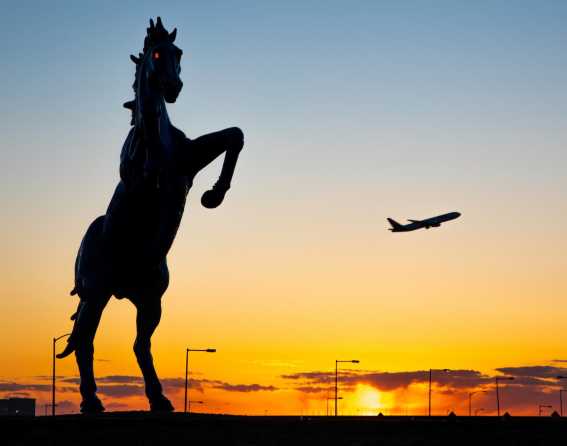
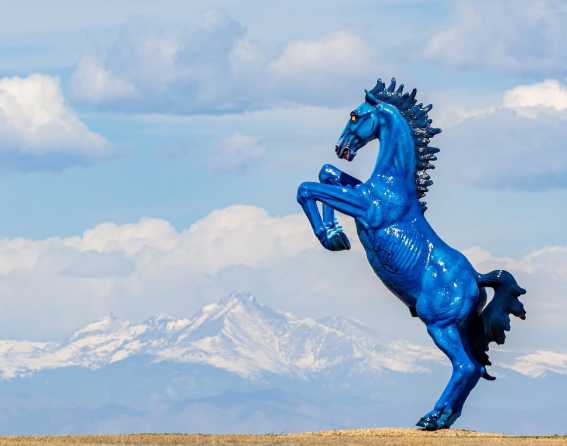
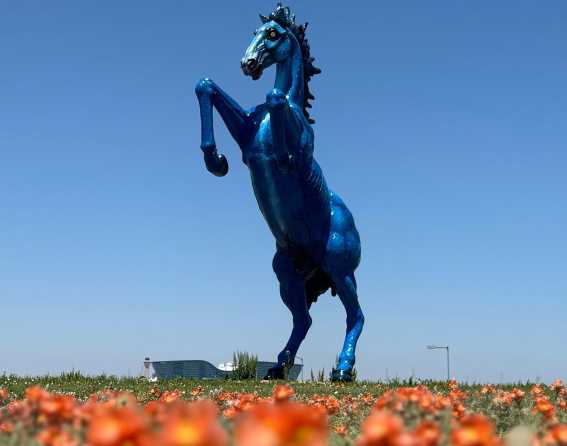
Standing sentry outside Denver International Airport (DEN), Blue Mustang is 32 feet of sheer cosmic horror, with a decidedly Western bent. His glowing red eyes, veined muscles and overall menace make for a polarizing landmark of public art that’s aptly known as “Blucifer.” You can’t miss him, even if you wanted to.
Some say Blucifer is an odd way to greet people, but others see the mad azure equine, reared up and snorting forevermore, as an apt ambassador for the Mile High City. He’s anything but forgettable.
The Artist Behind Blucifer: Luis Jiménez
Born in El Paso, Texas, in 1940, Luis Jiménez began his career in art at his father’s neon sign shop as a kid. He found his medium in the form of polychromed fiberglass and created three-dimensional sculptures that fused the working-class murals of Diego Rivera with the colorful pop art of Chicano culture.
In a 1984 interview with ArtForum, Jiménez said fiberglass was his medium of choice because it “is a statement in itself, one that can incorporate color and fluid form, the sensuality that I like. Somehow fiberglass seems to do that.”
Jiménez’s style coalesced during a year at the Roswell Artist-in-Residence program in southeastern New Mexico in the early 1970s. He subsequently set up shop in an old adobe schoolhouse and gymnasium in nearby Hondo, New Mexico, and his reputation as a dynamic and edgy public artist snowballed.
Many of his works generated controversy, but the establishment ultimately couldn’t deny his talent. Man on Fire, his iconic sculpture of Aztec Emperor Cuauhtémoc, ablaze yet defiant, is on display at the Smithsonian American Art Museum in Washington, D.C. President Bill Clinton designated his Southwest Pieta in Albuquerque an official National Treasure in 1999.
Denver’s public art program commissioned Blue Mustang in 1992. Jiménez originally envisioned a stampeding bison herd, but the horse concept was deemed more appropriate for the airport due to its connotation of travel in the West.
His beloved Appaloosa, Black Jack, served as the model for Blue Mustang, which was predated by four smaller-scale versions, including Mesteño at the University of Oklahoma and Black Jack, now part of the collection of the Grace Museum in Abilene, Texas.
Jiménez had numerous health problems during this period of time, including a heart attack and hand surgery, that slowed work on Blue Mustang to a crawl. Denver sued him for his $165,000 advance in the late 1990s, and Jiménez countersued, with the resolution being that the artist would continue and complete the project.
Tragedy in Hondo: Jiménez's Passing
On June 13, 2006, tragedy struck. As Jiménez was painting the head of Blue Mustang on June 13, 2006, a piece of the 9,000-pound sculpture fell from a hoist and pinned him to the floor of his Hondo studio. The accident severed his femoral artery, and he was declared dead on arrival at the nearest hospital at the age of 65. The Lincoln County Sheriff’s Office termed it an “industrial accident,” but that doesn’t do the tragedy justice. Jiménez was a man who lived and breathed art, and ultimately died from it.
Jiménez’s family and studio staff, with the help of a pair of professional lowrider painters, finished Blue Mustang and shipped it to California for final assembly. In February 2008, the horse finally arrived at DEN where a crew installed it between the northbound and southbound lanes of Peña Boulevard more than 15 years after its commissioning. His final piece exemplified his unforgettable style.
The studio in Hondo was listed on the National Register of Historic Places in 2014. The final resting site of Jiménez has been kept private, but his works on display all over the country are true memorials to his legacy.
From Controversy to Colorado Icon
The best art provokes a strong reaction one way or another. There’s no doubt that Blue Mustang falls into this category.
After its 2008 installation at Denver International Airport, the backlash was quick and strong. Anti-Blucifer websites and Facebook pages sprung to life, inviting critics to comment. One used haiku to express their sentiment: “Anxiously I fly / apocalyptic hell beast / fails to soothe my nerves.” Denverites tried out nicknames like “Devil Horse,” “Satan’s Steed,” and “The Blue Stallion of Death” before “Blucifer” took hold.
Post-9/11 security measures quashed a plan for a parking area. Late Denver public artist Lawrence Argent decried the inability to get up close and personal with Blucifer, telling the New York Times in 2009, “It’s a vista from afar, and to many it’s a frightening vista from afar.”
As the years went by, public opinion shifted. Like Argent’s I See What You Mean (the big blue bear at the Colorado Convention Center), Blucifer has since ascended to the status of Denver icon.
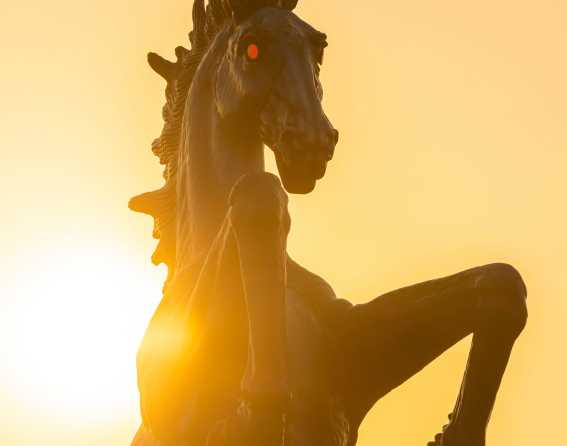
Like the shadow to I See What You Mean’s sunshine, Blucifer looks anything but amiable. His glowing red eyes (a nod to Jiménez’s father’s neon studio), veiny flesh, and exaggerated features project untamed aggression, but he definitely grows on you. Some of the fiercest initial critics have come to love Blucifer.
One thing is for sure: The city got its money’s worth. While Denver paid $650,000 for the sculpture, it insured it for $2 million in 2007, and there’s every reason to think it’s worth much more than that today.
Seeing (or Buying) Blucifer
There still is no parking area, so the best place to take a picture of Blucifer is from a passenger seat of a moving vehicle on Peña Boulevard. Some enterprising photographers have taken a shuttle or Uber around the loop at the terminal for the sole purpose of getting a shot of the blue behemoth; be sure to sit on the driver’s side for the best view.
Don’t fret: Simply seeing Blue Mustang will leave a lasting impression. The fleeting nature of the image makes it that much more powerful. As one Reddit commenter put it, “Simply looking upon Blucifer is enough to have his image etched upon your retinas for all time.”
Snapshots aside, the demonic stallion’s status as a cultural stalwart means Blucifer souvenirs are plentiful. Take your pick of Blucifer T-shirts and baseball caps, 3D-printed Blucifer replicas, Blucifer tote bags, earrings, ornaments, stickers, even Blucifer pressed pennies. Now there's even a music festival, Blucifer’s First Rodeo, held in the Baker neighborhood. The days of the big blue horse being branded a villain or an eyesore are long gone. He’s now irrevocably part of the city’s hearts and minds. Like the patron saint of DEN's conspiracy theories, Blucifer is an unforgettable reminder of the ferocity of nature and humanity’s tenuous grip on, well, everything.
Photos on this page are courtesy of Denver International Airport.