


The Colorado State Capitol is home to one of Denver’s most remarkable hidden treasures: the world’s largest known deposit of rose onyx. This rare, pink-hued stone lines the building’s interior, covering walls and columns in swirling shades that resemble a Rocky Mountain sunset. Look closely, and you might spot shapes emerging from the stone’s natural veining — a woman’s profile, a mountain landscape or ripples across a pond.
Rose onyx is just one of many architectural details that make the Capitol unforgettable, alongside its intricate stained glass, towering columns, gleaming brass chandeliers and iconic gold dome. But unlike many of the building’s grand features, this one invites you to get up close, run your hand across its polished surface and admire a material found nowhere else in the world.
What Is Rose Onyx?
Rose onyx is one of the rarest decorative stones. Despite its name (and its original nickname, Beulah red marble), it’s actually metamorphosed limestone. The distinctive swirls of rose, cream, blush and warm brown in the material were created by trace amounts of iron oxide that became trapped in the stone as it formed millions of years ago.
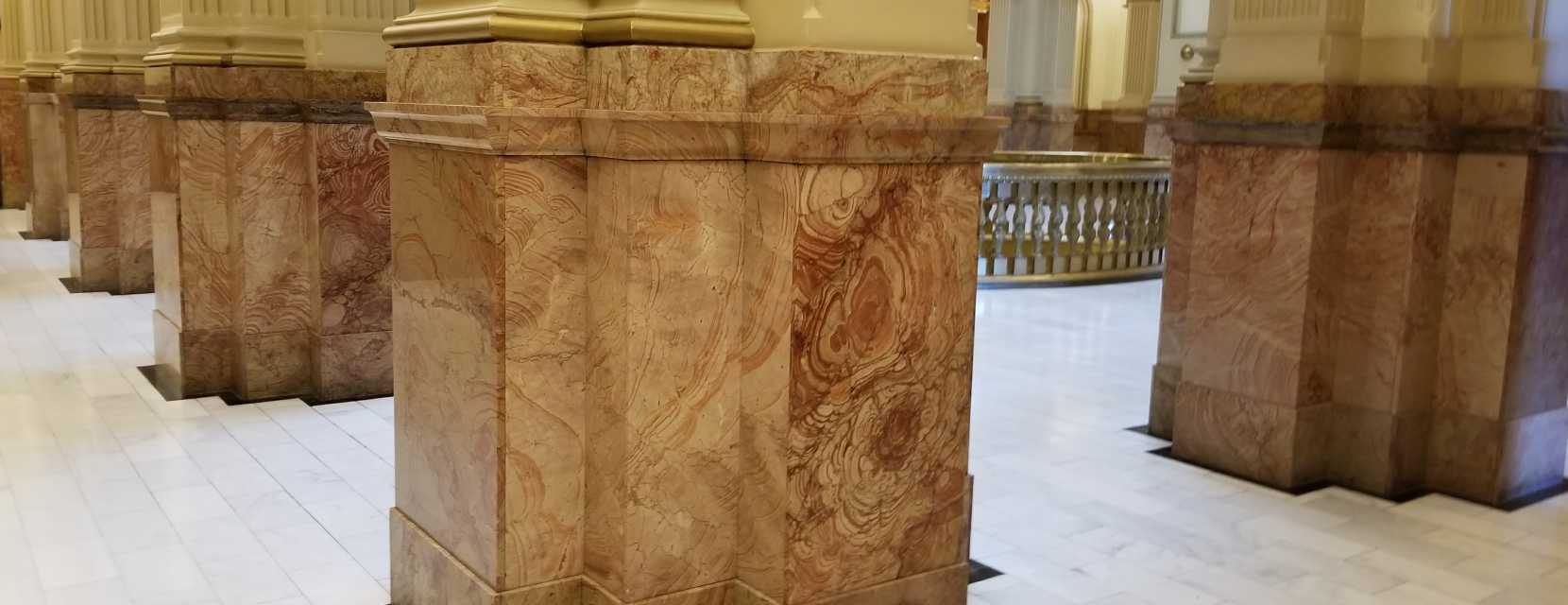
Rose onyx at the Colorado State Capitol
History of Rose Onyx
Rose onyx was discovered in the early 1890s near the small town of Beulah in south-central Colorado and quickly caught the attention of the Capitol’s architects. Today, it’s also known as Colorado rose onyx — and for good reason. The entire known deposit was quarried to create the Capitol’s wainscoting, columns and other interior details, making the building home to the world’s largest (and only) display of this remarkable stone.
Where to See Rose Onyx
The one place to experience rose onyx is the Colorado State Capitol, where the rare stone still lines the interior walls and the bases of many columns. Because the original Beulah quarry was completely exhausted, the Capitol maintains a small reserve of rose onyx in underground vaults for future restoration and preservation work.
For a deeper look at this one-of-a-kind stone — and the stories behind it — join one of the Capitol’s free guided tours. They're offered Monday through Friday, every hour from 10 a.m. to 3 p.m., with the first tour beginning at 10 a.m. and the last departing at 3 p.m.
More Things to See at the Colorado State Capitol
- Look down at the gleaming white Yule marble floors, crafted from Colorado’s state rock quarried in the town of Marble on the Western Slope. The same marble was later used to build the Lincoln Memorial and the Tomb of the Unknown Soldier in Washington, D.C.
- See the “Women’s Gold” quilt, a colorful tribute to remarkable Colorado women, including entrepreneur Clara Brown, playwright Mary Chase and Saint Frances Xavier Cabrini (Mother Cabrini).
- Snap a photo at the famous “One Mile Above Sea Level” marker on the Capitol steps — then take a guided tour to learn why there are actually three mile-high markers.
- Admire the restored House of Representatives chamber, painstakingly returned to its original grandeur after decades hidden beneath 1950s acoustic tiles.
- Find the stained-glass portrait of Emily Griffith, the pioneering educator who founded the Emily Griffith Opportunity School, which has served millions of students.
- Step into the Old Supreme Court Chamber to admire stained-glass windows honoring the Hispanic, Indigenous, African American, Chinese and Japanese communities that helped shape Colorado.
- Climb to the dome’s observation deck (available on guided tours only) for sweeping views of downtown Denver and the Rocky Mountains.